Tree Struck by Lightning: When to Worry
Georgia’s weather is notoriously fickle, but in these hottest summer months, we know to expect frequent storms. Heavy rains, booming thunder, and of course, flashing lightning. The winds and water are enough to cause tree failure, of course, but the lightning is an oft-overlooked threat.
Why Does Lightning Strike Trees?

Lightning struck this tree and blew off a strip of bark.
To understand why lightning strikes trees, let’s go back to elementary-school science for a minute. Lightning is an electrical discharge between two areas that have imbalanced electrical charge. Nature likes things to be balanced, so when one area is more negatively charged than another, some of the negative charge will jump to the positively-charged area in a big surge. That surge is what we call lightning. Most lightning occurs when electricity discharges from one cloud to another, or from a cloud to the ground.
When lightning discharges from a cloud to the ground, the electricity will take the shortest possible route, and will be drawn to any nearby conductors (things that electricity can pass through). Trees stand tall above the ground, shortening the distance the lightning has to free travel through the air. Trees are also full of moisture, making them a great conductor. These two factors make them ideal targets for lightning strikes.
What Happens When a Tree is Struck by Lightning?

The strip of missing bark goes all the way up the tree!
Lightning contains a massive amount of energy – 200 megajoules to 7 gigajoules, to be exact – that gets released almost instantaneously. That much power, that fast, can do a lot of damage. The extent of that damage depends on a few things, like the strength of the lightning and the size and preexisting condition of the tree.
Smaller, weaker lightning strikes might just see some bark go flying, or a branch snap and break off. Larger, stronger strikes, though, might see the tree catch fire, or even fully explode upon impact.
If the tree had any preexisting weak points, such as a broken branch, internal rot or decay, a pest infestation, etc, then these points are likely to be more seriously affected by the lightning. Of course, lightning is powerful enough to take down even the healthiest of trees, so just because your tree is doing fine doesn’t mean it’s not at risk.
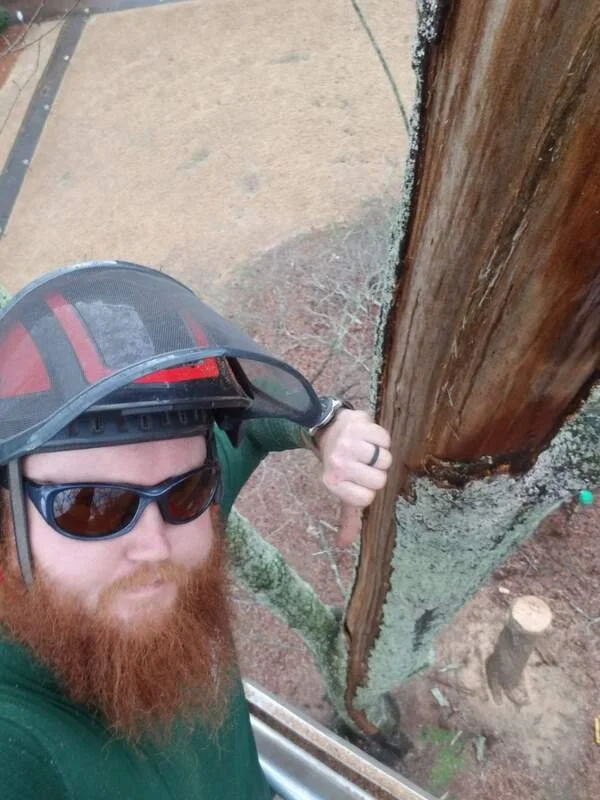
Our Certified Arborist, Scott, gives the damage a thumbs-down!
When Should I Worry?
There’s plenty of damage lightning can cause that’s perfectly visible – flying bark, broken branches, fire. But lightning often causes significant internal damage that compromises the tree’s structural integrity. Lightning is also incredibly damaging to the tree’s root system. This can lead to full tree failure.
All the images in this article are of a tree we were contracted to remove that was struck by lightning, as you can see by the missing bark. The damage runs in a long strip all the way up the tree, with some sections wider than others. What you can’t see is the internal damage the lightning did, damage that would eventually cause the tree to die.
It’s cases like this that mean you should always, always have a tree that’s been struck by lightning evaluated by a Certified Arborist. Even if the damage on the outside looks minimal, there could be something dangerous going on inside (or under the ground!) that you can’t see at all.
It’s also important to have your tree assessed as soon as possible after the strike. The longer you wait, the worse that internal damage can get. This increases the threat the tree poses to your home and family, and it can also make the removal process more difficult and more dangerous, which could cost you more in the long run.
Is Removal the Only Option?
We’ve stressed the dangers of a lightning-damaged tree, because they can pose a serious threat to surrounding persons and property. But just because a tree was struck by lightning doesn’t automatically mean it will have to be removed. Trees are resilient. Depending on the level of damage, they may be able to recover on their own, or with some assistance (such as pruning, fertilizer, etc). But it’s always best to have a Certified Arborist assess the tree to make that call.
If you’ve had a tree struck by lightning, don’t wait! Contact Classic City Arborists in the Athens, Georgia area today to schedule a free quote!