• Home
  • Services
  • Free Estimates
  • Photo Gallery
  • News And Blog
  • Reviews
  • About
  • Contact
News and Blog Articles

The Creeping Killer: Why Ivy Is Bad for Your Trees

4/14/2018

0 Comments

 
Picture
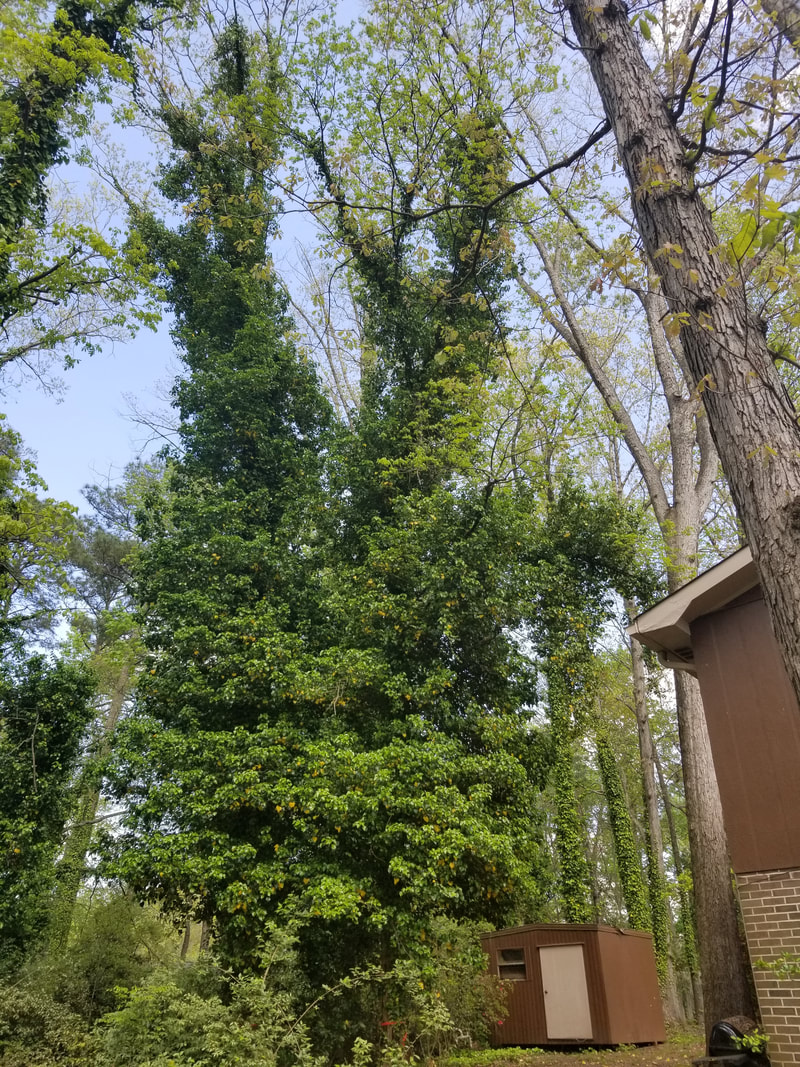
If you’ve ever wandered around Oconee or Athens, you’ve probably seen some of the many trees that are covered in ivy. They can look pretty, with their draping vines and vibrant leaves. But unfortunately, all of these trees have one foot in the grave, and actually pose a risk to the people and structures around them. 

What is Ivy?

Ivy is the common name for a variety of woody vine species in the genus Hedera L. The one you’ve probably seen in our area is most likely Hedera helix, also known as English Ivy or Common Ivy. As the name suggests, the vine is native to much of Europe, but it’s an invasive species in America. It was brought over by colonial settlers in the early 1800s, and has run rampant across the continent in the centuries since, growing across yards in a thick carpet and overtaking trees and buildings alike in a smothering blanket.
Picture

Why is Ivy A Problem?

Ivy grows quickly – 8 to 9 feet a year! – so it doesn’t take long for it to start covering a tree’s leaves. This blocks the tree’s access to sunlight, which in turn restricts the tree’s ability to photosynthesize. With whole sections of leaves covered in ivy, the tree won’t be able to generate enough nutrients to support itself. The covered portions of the canopy will start to die back, and these dead spots are hotspots for pests and decay, further compromising the tree’s health. Ivy is a preferred hangout for all kinds of insects and pests that will happily feed off the tree and take advantage of rotted sections to burrow in deep.
​Ivy is also much heavier than it looks. The amount of thick, woody vines it takes to climb up a whole tree, not to mention the mass of leaves, means that the tree is holding up hundreds pounds of extra weight. With the structural integrity of the tree already impacted by lower nutrient intake (and sometimes pest infestation and decay), all that weight becomes that much more dangerous to bear. 
The final problem ivy presents is disguise. It’s impossible to spot the signs of decay or pest infestation if you can’t see through the ivy to the tree itself. The whole thing might be entirely dead and just waiting for a strong wind to knock it over, and you’d never know, because the ivy growing all over it is green and thriving.
Picture

​Can’t I Just Leave It?

​Ivy is incredibly difficult to deal with once it’s overtaken a tree. Removing the tree is often the best course of action to reduce risk, as most trees can’t survive long covered in ivy. But it’s not safe to just cut the tree down, ivy and all – those hidden signs of decay and structural failure mean that it’s impossible to predict how the tree will come down. That means you can’t control the removal, and someone (or something, like your house!) could get hurt. So before an ivy-covered tree can be removed, the ivy has to be dealt with first. The extra time and effort required to do so can increase the cost of removal 1.5 to 2 times, making things much more expensive. 
Of course, you could just leave the ivy-covered tree to its own devices, but that is never recommended. A covered tree is almost certainly a dead or dying tree, and dead or dying trees almost certainly fail. 

​So What Can I Do?

Luckily, taking care of ivy growing on your tree isn’t actually all that difficult. Ivy, like any other plant, has a root system it relies on for a significant portion of its nutrients. If you cut off the choking vines from their root system, they’ll wither and die, and then fall off your tree on their own. Prune the ivy around the base of the tree it’s growing on, cutting away the lower 4 to 5 feet (about chest to shoulder height). Use a hand saw, or pruning shears if the vines aren’t too thick – just don’t use a chopping tool, like an axe or a machete. It’s much too easy to cut through the ivy and into the tree trunk, damaging the tree.
Picture
Remove the lower section of the ivy, throw away the cuttings, and that’s it! Anything higher than what you cut will die off. Of course, the root system is still there, and it might try to grow back. But once you’ve cut it back once, it’s much easier to cut it back a second time, especially if you add it as an annual yard maintenance. 
Have an ivy-covered tree you’re worried about? Not able to prune back the ivy yourself? Give Classic City Arborists a call today for a free quote!

Author

Emily Casuccio is sister and sister-in-law to Rebekah and Scott Rushing, and has worked with Classic City Arborists for the last 5 years. In addition to handling administrative tasks and customer communication (she’s the voice you’ll hear on the phone!), Emily is an experienced copywriter, editor, and storyboard consultant. To learn more about her, read samples of her work, or contact her, visit her online portfolio.

Sources:
USDA Natural Resources Conservation Service
USDA FEIS Database
0 Comments

    Categories

    All
    Arboriculture Today
    Current News
    Job Spotlight
    Small Business News
    Tree Of The Month

    Archives

    April 2025
    March 2025
    February 2025
    January 2023
    August 2022
    July 2022
    June 2022
    May 2022
    April 2022
    March 2022
    February 2022
    January 2022
    December 2021
    November 2021
    October 2021
    September 2021
    August 2021
    July 2021
    June 2021
    May 2021
    April 2021
    March 2021
    February 2021
    January 2021
    December 2020
    November 2020
    October 2020
    September 2020
    August 2020
    July 2020
    June 2020
    May 2020
    April 2020
    March 2020
    February 2020
    October 2019
    January 2019
    April 2018
    February 2017
    December 2016
    May 2016
    April 2016

Logo
Contact Form

Classic city arborists

P.O. Box 1754
Watkinsville, GA 30677
[email protected]

Office Phone

(706) 410-0227

scott rushing, Owner

(706) 340-9370

23   Whatever you do, work at it with all your heart, as working for the Lord, not for human masters, 
24   since you know that you will receive an inheritance  from the Lord as a reward.  It is the Lord Christ you are serving. 
​ Colossians 3:23-24

  • Home
  • Services
  • Free Estimates
  • Photo Gallery
  • News And Blog
  • Reviews
  • About
  • Contact